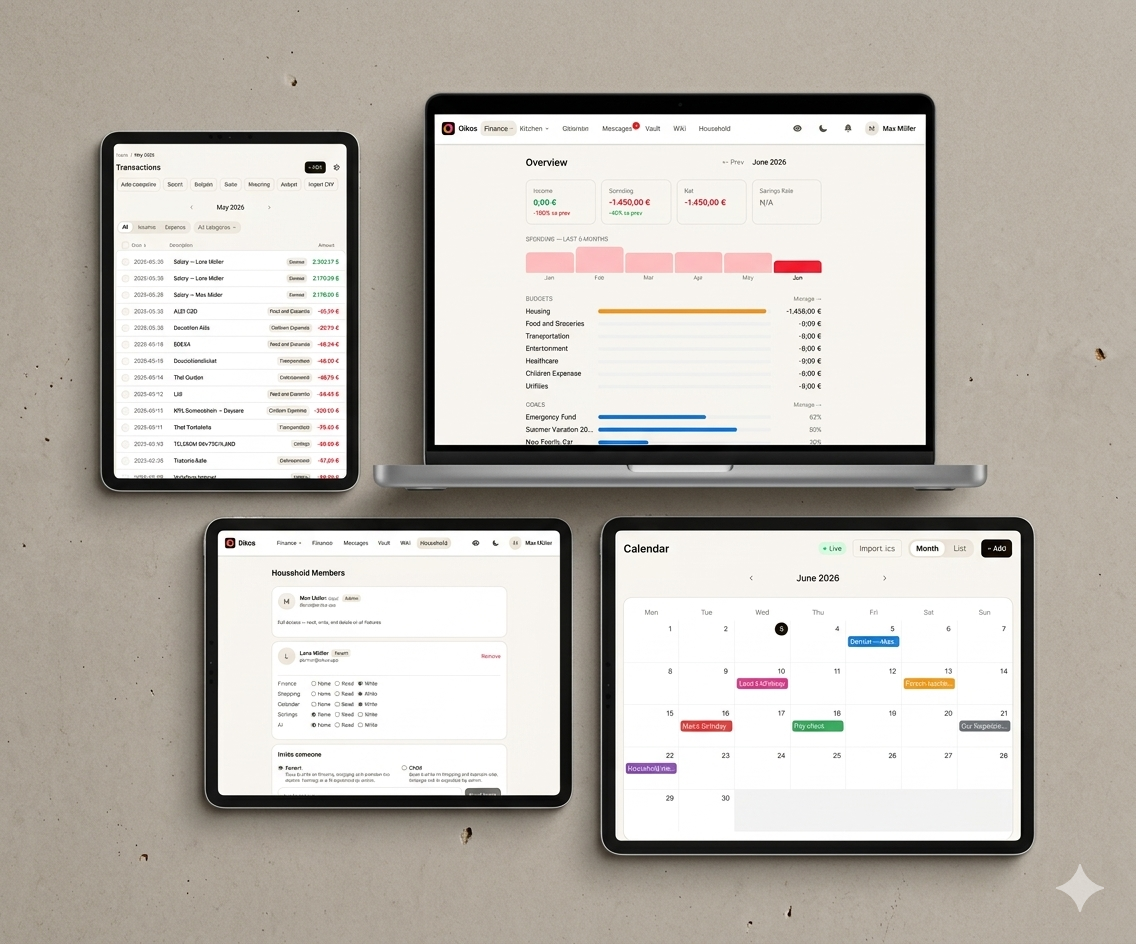
How I use it
This is the app my partner and I open several times a day to run the flat. Someone adds oat milk to the shared shopping list on the way home and it shows up on the other phone in the same second. The same goes for the calendar, a quick message, or a note about who is paying for what.
Money is the part that used to cause friction. Once a month I export the transactions from the bank, drop the CSV into Oikos, and it works out which of the six German banks the file came from by reading its headers. From there a local model reads each transaction and sorts it into a category on its own, so the rows that used to need manual tagging just land in the right place.
On top of that I can ask it to look at a stretch of time, whether that is the last month, three months, six months, or a full year, and it comes back with a proper written report instead of a wall of numbers. It points out where the money actually went over that period and which categories quietly crept up, then gives concrete suggestions on where we could reasonably cut back. It turned the monthly 'where did it all go' conversation into something we can answer in a few seconds.
It also holds the things we would otherwise text each other in the clear, like the Wi-Fi password or shared logins, in a vault that is encrypted end to end. The keys are derived on the device, so the server only ever stores ciphertext and never sees what is inside. Because it is a PWA with web push, it sits on the home screen like a normal app and can nudge us when something needs attention.
It is also a real, shipped product rather than a portfolio mockup. It runs on Vercel, earns its place in our actual household, and keeps gaining features whenever we run into something we wish it did.
Try it live
You are welcome to try it for real. Register your own household and play along, or sign in with the demo account below. Both demo logins share one household, so you can open them side by side and watch a change on one appear on the other in real time.
Open the live app →Demo account
Architecture


1
Next.js deployment
Supabase
Auth · DB · Realtime · Storage
RLS
row-level security
PWA
installable · web push
Stack